
The Supreme Court is scheduled to hear a plea on August 8 seeking directions to the Centre for the restoration of statehood to Jammu and Kashmir. The plea highlights concerns about the delay and its impact on democratic rights and development.

The 10-day Ganesh festival has begun in Maharashtra, with devotees welcoming Lord Ganesha into their homes and public pandals. The state government has declared the celebrations a state festival for the first time.

Leading Kuki-Zo groups in Manipur welcome Prime Minister Narendra Modi's likely visit, hoping he will address their aspirations for a separate administration and lasting peace in the region affected by ethnic violence.
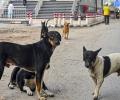
The Supreme Court will hear a suo motu case regarding the relocation of stray dogs in Delhi-NCR following widespread protests against an earlier order. A new three-judge bench will review the matter, focusing on the implementation of animal birth control rules and the creation of adequate shelters.

The BJP has accused the Opposition of spreading propaganda regarding the Supreme Court's stance on Aadhaar and voter enrollment in Bihar. The party asserts that the court did not state Aadhaar alone is sufficient for voter registration and that the Opposition is misrepresenting the ruling.

An uneasy calm prevails in Ladakh as authorities enforce a curfew following clashes between security forces and protesters demanding statehood and constitutional protections. The violence resulted in fatalities and injuries, prompting detentions and political reactions.
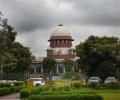
A five-judge Constitution bench of the Supreme Court is scheduled to consider the Presidential reference on whether timelines could be imposed by judicial orders for the exercise of discretion by the President while dealing with bills passed by state assemblies.

The Supreme Court told actor and BJP MP Kangana Ranaut that she had "added spice" to a retweet during the 2020-21 farmers' protest, leading her to withdraw her plea for quashing a defamation complaint.

The magnitude of the new H-1B visa application fee for fresh petitions - math of which works out to USD 500 million in case of 5,000 filings - may nudge IT companies to expand offshore delivery or increase local hiring, according to Motilal Oswal Financial Services.

The Supreme Court is examining the extent to which courts can intervene when governors delay or refuse to act on bills passed by state assemblies. The court questioned the Centre on whether judicial review is barred in cases of gubernatorial inaction, sparking debate on the balance of power between states and the central government.

ISL Imbroglio: AIFF calls for meeting between legal counsels of federation and clubs

No headway in meeting between AIFF and FSDL
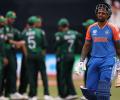
'Engaging with Pakistan at this stage sends out a message that undermines the sentiments of the people of India who stand firmly against any compromise on national security.'

In a big boost to tycoon Gautam Adani, markets regulator Sebi on Thursday cleared the billionaire and his group of stock manipulation allegations made by US short-seller Hindenburg Research, saying fund transfer between group companies did not fall foul of any regulation.
The CBI will seek police remand of eight Jammu and Kashmir Police personnel arrested for allegedly inflicting brutal custodial torture on a fellow constable in 2023. The case involves allegations of severe abuse and mutilation, leading to a Supreme Court-ordered investigation.
The Supreme Court of India dissolved a marriage, instructing the couple to prioritize their child's well-being and set aside personal differences.

55 road accidents, 20 deaths every hour.
The Supreme Court has raised concerns about discrimination against persons with disabilities in employment, questioning the Centre on the lack of 'upward movement' for meritorious candidates. The court also ordered nationwide monitoring of care institutions for persons with cognitive disabilities.
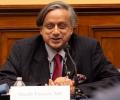
Senior Congress leader Shashi Tharoor says US tariffs are negatively impacting India, leading to job losses, and criticizes President Trump's diplomatic behavior.
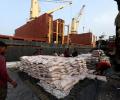
Apex exporters body FIEO on Tuesday expressed serious concerns over high US tariffs on Indian goods and said that textiles and apparel manufacturers in Tirupur, Noida, and Surat have halted production amid worsening cost competitiveness due to these steep duties. The US duties on Indian goods will increase to 50 per cent from August 27.

India's forex reserves increased by $5.17 billion to $696.65 billion for the week ended June 6, the RBI said on Friday. The overall reserves had dropped by $1.24 billion to $691.49 billion for the week ended May 30.
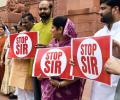
The Supreme Court has warned that it will set aside the special intensive revision (SIR) of electoral rolls in Bihar if any illegality is found. The court is reviewing the validity of the Bihar SIR and its potential impact on a similar exercise across India.
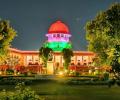
The Centre told the Supreme Court that governors are not indefinitely sitting on bills passed by state legislatures, and that barring a few exceptions, most have acted in a way which the apex court would have perhaps desired. Solicitor General Tushar Mehta argued that a Governor is "not a rubber stamp" and has a duty to preserve, protect, and defend the Constitution.

You have to grow, and grow fast - that's the DNA of the JSW group, chairman Sajjan Jindal said as JSW Cement made its debut on the stock market mid-August. The remark captured not just the moment but also the momentum of JSW's growth story.
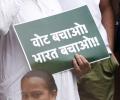
A resident of Bhojpur district in Bihar on Thursday called on the Chief Electoral Officer of the state to plead that he was alive.

Former Jharkhand chief minister and BJP leader Champai Soren was placed under house arrest on Sunday to prevent law and order issues in view of a protest by tribal outfits against land acquisition for a multi-crore state-run health institute, police said.
"They (government) are taking good care of whatever is possible," the bench observed.
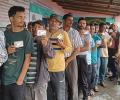
The Election Commission has assured the Supreme Court that no voter's name will be deleted from the draft electoral roll in Bihar without prior notice and a fair hearing. The EC also clarified that it is not required to share separate lists of those not included in the draft rolls.

The council said it takes serious cognisance of the alleged data manipulation by the CSDS and its attempt to create a narrative to undermine the sanctity of the Election Commission of India (ECI).

The Supreme Court on Friday modified its August 11 direction prohibiting release of stray dogs from pounds in Delhi-NCR and said the picked up canines should be sterilised, vaccinated and released back in the same area.

'Life in India is better only for those who have reservations.'

A group of retired judges has criticized Home Minister Amit Shah's remarks about opposition vice-presidential candidate B Sudershan Reddy and the Salwa Judum judgement, calling them 'unfortunate'.
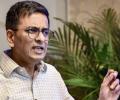
In an unprecedented move, the Supreme Court administration has written to the Centre for vacating the official residence of the Chief Justice of India at Krishna Menon Marg in New Delhi, noting that the current occupant ex-CJI D Y Chandrachud has stayed beyond the permissible period.

The Supreme Court dismissed Allahabad High Court judge Yashwant Varma's plea seeking invalidation of a report that found him guilty of misconduct in the cash discovery row.

The Supreme Court has ordered authorities not to take coercive action against owners of diesel vehicles over 10 years old and petrol vehicles older than 15 years in Delhi-NCR.

"Considering the importance of the matter, subject to the order of the Chief Justice of India, the matter be placed for final hearing on July 22," the bench said.
India's forex reserves dropped by $1.24 billion to $691.49 billion for the week ended May 30, the RBI said on Friday. The overall reserves had jumped by $6.99 billion to $692.72 billion in the previous reporting week.

The final contours of the theaterisation process could involve the establishment of two integrated theatre commands to counter Pakistan and China, along with a third maritime theatre command.
A plea has been filed in the Supreme Court seeking the removal of Madhya Pradesh minister Vijay Shah for his remarks against Indian Army officer Col Sofiya Qureshi. The petition, filed by a Congress leader, alleges Shah's statement sparks separatist feelings and threatens the country's unity.

The Centre told the bench that compensation to the beneficiaries was already paid and the land was acquired but subsequently, one person, on the strength of a power of attorney, filed a reference case.
